Pre-landfall decision-making

Make the right call before the storm arrives

Every season, utilities, logistics networks, retailers, and infrastructure operators make expensive decisions before they have certainty. Stage crews or wait. Shut down a site or stay open. Reroute freight or hold course. Protect assets now or risk avoidable loss later.


Trusted by the world's top risk professionals

Trusted by the world's top risk professionals

THE CHALLENGE

Therealproblemisn'ttheforecast.It'sthedecision.

It's October 7th, 2024. Hurricane Milton's forecast cone stretches across Florida's west coast. Your assets, crews, customers, and supply chain may all be in the impact zone, but the exact outcome is still uncertain.

Move too early, and you absorb unnecessary mobilization, shutdown, staffing and logistics costs. Move too late, and you face restoration delays, service failures, damaged assets, regulatory scrutiny, and avoidable financial loss.

THE IMPOSSIBLE CHOICE

Most tools still force binary decisions in a probabilistic world

The NHC cone, deterministic tracks, weather alerts, and internal playbooks are all useful inputs. But they rarely answer the question operators need to answer: What is the probability of exceeding our action threshold at this location, and is that probability high enough to justify the cost of acting now?

The NHC forecast cone

The gold standard for public hurricane forecasting and the right tool for evacuation planning. At your facility, a regional forecast is not a number you can act on.

Your local analytics provider

Single deterministic trajectories. One answer, no odds. When the track shifts overnight, you're starting over, because nobody told you that shift was already in the range of possibilities.

Running a full-physics ensemble model

Accurate, but too slow for operational use. Too few simulations means the range of possibilities is underrepresented when it matters most.

Your in-house weather team

Valuable for monitoring. But watching the storm isn't the same as knowing the odds at your specific location.


THE SOLUTION

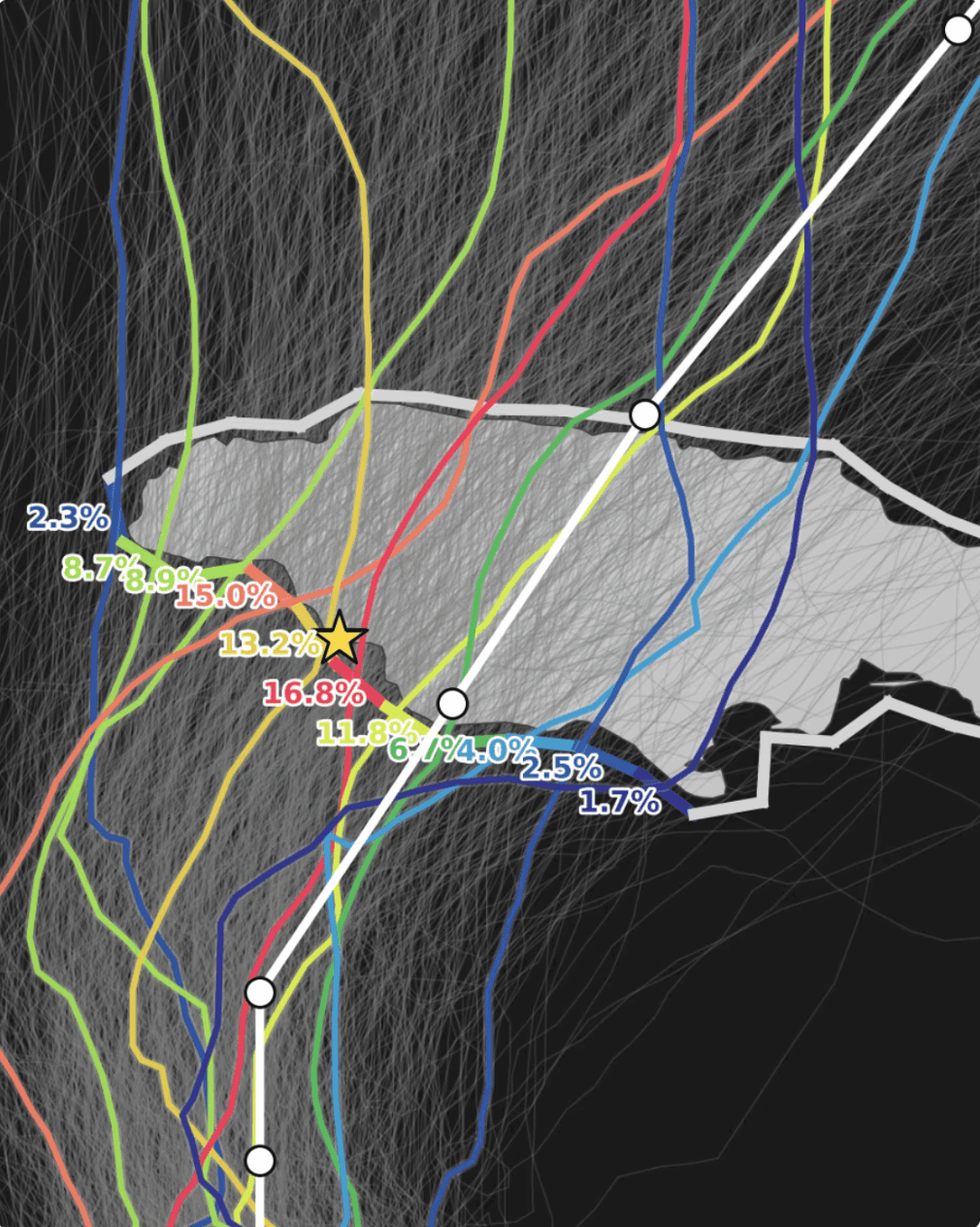
1,000 realistic scenarios. Your site. Updated every six hours.

LiveCyc generates 1,000 simulated storm scenarios grounded in the current storm, giving you a probability at your specific location you can build a decision table around.

SITE-LEVEL PRECISION

Your coordinates. Your terrain. Your risk.

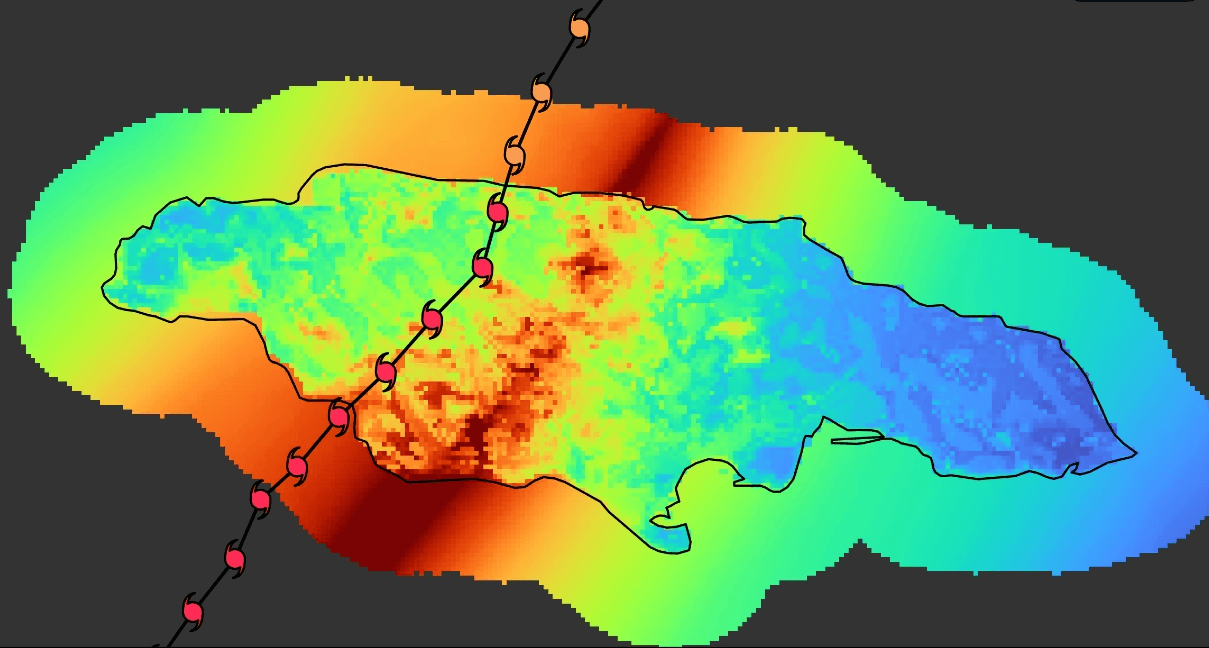
Every site is different. Terrain, surface roughness, wind direction: they all change what a storm means at your specific location. LiveCyc accounts for all of it, translating the forecast into a wind speed distribution at your exact coordinates.

1km resolution wind fields over real-world terrain

Corrected for topography and surface roughness

Site-level exceedance probability, not a regional average.

Metryc wind field map showing asymmetric wind speed distribution across a Caribbean island during a Category 4 hurricane landfall

LiveCyc Scenarios

Your coordinates. Your terrain. Your risk.

Every site is different. Terrain, surface roughness, wind direction: they all change what a storm means at your specific location. LiveCyc accounts for all of it, translating the forecast into a wind speed distribution at your exact coordinates.

1km resolution wind fields over real-world terrain

Corrected for topography and surface roughness

Site-level exceedance probability, not a regional average.

Metryc wind field map showing asymmetric wind speed distribution across a Caribbean island during a Category 4 hurricane landfall

SITE-LEVEL PRECISION

Your coordinates. Your terrain. Your risk.

Every site is different. Terrain, surface roughness, wind direction: they all change what a storm means at your specific location. LiveCyc accounts for all of it, translating the forecast into a wind speed distribution at your exact coordinates.

1km resolution wind fields over real-world terrain

Corrected for topography and surface roughness

Site-level exceedance probability, not a regional average.

Metryc wind field map showing asymmetric wind speed distribution across a Caribbean island during a Category 4 hurricane landfall
Stacked wind field layers representing 100 physically-grounded Metryc simulations of a single tropical cyclone event, illustrating explicit uncertainty modelling

PROBABILISTIC FORECASTING

The full range of what could happen, with odds on each.

Three days out, there may be 20 or more landfall scenarios to consider. LiveCyc assigns a probability to each. As you get closer to landfall the distribution narrows, the number sharpens, and the decision your team needs to take becomes mechanical.

Up to 30 scenarios three days out, narrowing as landfall approaches

Each scenario includes a wind footprint and probability of occurrence

Updated every six hours throughout the event

Stacked wind field layers representing 100 physically-grounded Metryc simulations of a single tropical cyclone event, illustrating explicit uncertainty modelling

PROBABILISTIC FORECASTING

The full range of what could happen, with odds on each.

Three days out, there may be 20 or more landfall scenarios to consider. LiveCyc assigns a probability to each. As you get closer to landfall the distribution narrows, the number sharpens, and the decision your team needs to take becomes mechanical.

Up to 30 scenarios three days out, narrowing as landfall approaches

Each scenario includes a wind footprint and probability of occurrence

Updated every six hours throughout the event

Stacked wind field layers representing 100 physically-grounded Metryc simulations of a single tropical cyclone event, illustrating explicit uncertainty modelling

PROBABILISTIC FORECASTING

The full range of what could happen, with odds on each.

Three days out, there may be 20 or more landfall scenarios to consider. LiveCyc assigns a probability to each. As you get closer to landfall the distribution narrows, the number sharpens, and the decision your team needs to take becomes mechanical.

Up to 30 scenarios three days out, narrowing as landfall approaches

Each scenario includes a wind footprint and probability of occurrence

Updated every six hours throughout the event

What this means for your operations 

From forecast to decision.

Earlier mobilization decisions

Fewer unnecessary costs

Faster resource reallocation

More defensible decisions

PROOF OF CONCEPT

A framework used by organisations that can't afford to get it wrong

Built for the moment the number crosses your threshold.
VALIDATED FRAMEWORK

The threshold framework for high-value assets

The NRL's published Tropical Cyclone Conditions of Readiness framework uses the same probability-first logic LiveCyc is built on. Pre-agreed thresholds, back-tested against historical events, agreed with your team before the season starts.

VALIDATED FRAMEWORK

The threshold framework for high-value assets

VALIDATED FRAMEWORK

The threshold framework for high-value assets

Who we serve

Electric utilities

Stage mutual aid, position crews, prioritize restoration, protect critical infrastructure, and support regulatory defensibility with probability-based storm decisions. 

Global operations and logistics 

Protect sites, adjust staffing, reroute freight, reposition inventory, and maintain continuity across distributed networks of stores, warehouses, fulfillment centers, and transport routes. 

Asset managers and infrastructure investors

Understand asset-level exposure, portfolio disruption risk, and forward-looking resilience needs across physical infrastructure holdings. 

Telecom and subsea cable operators

Assess coastal landing stations, towers, network nodes, backup power requirements, and restoration priorities before and after major storm impacts. 

Ready before the first storm forms

Define your action thresholds before the season. Back-test them against past events. Then use LiveCyc during live storms to know when to escalate, hold, reallocate, or stand down.

Ready before the first storm forms

Define your action thresholds before the season. Back-test them against past events. Then use LiveCyc during live storms to know when to escalate, hold, reallocate, or stand down.

Stay in the loop

Sign up for the Reask newsletter for the latest climate science, model updates, and industry insights *

* By subscribing, you agree to receive the Reask newsletter. You can unsubscribe at any time. For more details, see our Privacy Policy.

2026 © Reask

All rights reserved

Stay in the loop

Sign up for the Reask newsletter for the latest climate science, model updates, and industry insights *

* By subscribing, you agree to receive the Reask newsletter. You can unsubscribe at any time. For more details, see our Privacy Policy.

2026 © Reask

All rights reserved

Stay in the loop

Sign up for the Reask newsletter for the latest climate science, model updates, and industry insights *

* By subscribing, you agree to receive the Reask newsletter. You can unsubscribe at any time. For more details, see our Privacy Policy.

2026 © Reask

All rights reserved